Abstract
Standard AI translation metrics — BLEU, METEOR, chrF, TER, COMET — perform poorly on Inuktitut, a polysynthetic language whose morphological richness is not well captured by surface-similarity or reference-embedding measures. To assess translation quality for Inuktitut in a way that reflects how translations are actually read and understood, Heritage Lab developed a blind pairwise-comparison platform judged by community members and expert translators. This document reports the methodology and current results of that evaluation. On the leaderboard, the Heritage Lab translator holds the top position, with Bing Translate in second and Google Translate in third.Background
Existing automatic evaluation metrics for AI translation were developed for high-resource languages with relatively rigid morphology. Inuktitut is polysynthetic: a single word can encode the meaning of a full English sentence through stacked morphemes expressing tense, agent, object, mood, and evidentiality. Two valid translations of the same reference can share very little surface form, and two translations that appear near-identical can differ in grammatical features that change the meaning. Metrics that reduce to n-gram overlap or reference-embedding similarity do not reliably track quality under these conditions. Human pairwise judgment, aggregated across many evaluators and many sentence pairs, remains the most reliable signal available for translation quality in low-resource, morphologically rich languages. Our translation evaluation platform was designed to collect this signal at scale for Inuktitut.Methodology
Pairwise Comparison
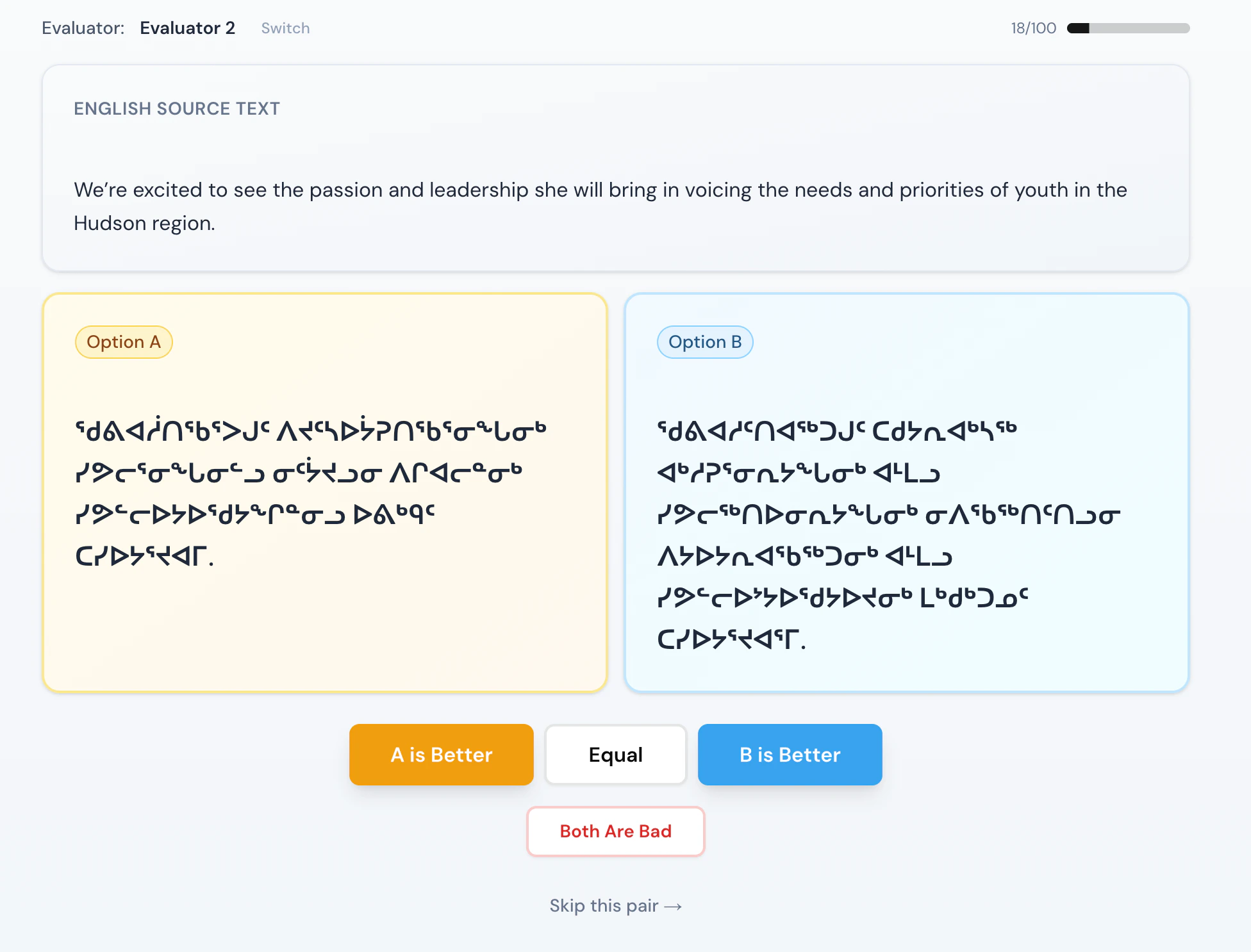
Each evaluation presents the participant with a reference sentence and two candidate translations, labeled A and B. System identities are not shown. The participant selects one of four options: A is Better, B is Better, Both are good, or Both Are Bad.
Elo Rating
The platform aggregates pairwise judgments using the Elo rating system. Each system starts with a rating of 1000. The expected score for system in a match against system is and the post-match update is where is the actual result and is the scaling constant used throughout this evaluation. Both tie options (Both are good and Both Are Bad) are treated identically as draws; the distinction is retained only to capture evaluator feedback about absolute quality.Reliability Target
The platform targets a minimum of fifty matches per system before any result is treated as stable. All three systems reported here are within this range.Results
Leaderboard
| Rank | System | Elo rating | Matches | Wins | Losses |
|---|---|---|---|---|---|
| 1 | Heritage Lab (JAN-20-M) | 1060 | 37 | 26 | 11 |
| 2 | Bing Translate | 1005 | 38 | 15 | 23 |
| 3 | Google Translate | 951 | 37 | 15 | 22 |
Observed Win Rates
Across all matches on the platform, the three systems recorded the following aggregate win rates: Heritage Lab 70.3%, Bing 39.5%, Google 40.5%. The observed rates are consistent with the Elo separation between systems.Interpretation of Elo Differences
The Elo Scale is Logarithmic
Elo differences do not correspond linearly to quality differences. Under the standard Elo formulation with a 400-point scale parameter, each successive 100-point gap increases the odds ratio by a factor of 1.78, roughly doubling the expected odds that the higher-rated system is preferred in a head-to-head match. Small-looking differences in raw rating therefore correspond to substantial differences in observed preference frequency over repeated trials.Relative, Not Absolute
An Elo score is a relative quantity. It expresses how often a system is preferred in comparison to the other systems on the platform, on the sentences currently included in the evaluation. It does not assign an absolute quality value, and cross-leaderboard comparisons (for example, to Elo scores from chess or from other NLP arenas) are not meaningful.Limitations
The results reported here reflect a single snapshot of an ongoing evaluation. Elo rankings are inherently dependent on match distribution; under sparse or uneven sampling they can fluctuate more than the underlying quality of the systems would suggest. The reported leaderboard should be treated as the current best estimate from the evaluation platform, not as a final ranking. Results will continue to evolve as additional evaluations are collected and as the platform is extended to cover additional dialects and sentence types.Next Steps
Ongoing and planned work on the evaluation platform includes increasing the number of evaluators per system, publishing dialect-specific leaderboards as volume permits, expanding the reference sentence set to cover additional domains and registers, and feeding evaluator feedback into the continued development of the Heritage Lab translator.Participation
Inuktitut speakers, language keepers, and expert translators are invited to contribute evaluations through our translation evaluation platform. Broader participation improves the statistical reliability of the leaderboard and supports community ownership of the ranking.Contributors
- Shaun Annanack, Siasie Ilisituk — translation testing
- Anissa Jean, Ali Mehdi — statistics & platform
Leaderboard figures reflect the evaluation snapshot from April 15, 2026. The platform is continuously updated; consult the live leaderboard for current figures.